I have not posted since the end of 2025. I needed to time away to woor on other projects. I will be posting less frequently – twice a month and will be moving to substack in the next couple of months. This shouldn’t cause much disruption as my URL will remain the same. With the housekeeping announcement out of the way, let’s move on to material based sustainability matters.
Cities reveal their values through their materials. Concrete declares speed and certainty. Steel signals ambition. Laterite whispers continuity. Across West and North-West Africa, laterite lies beneath our feet. Builders often crush it for roads or carve it as cladding. Few trust it as structure. That hesitation reflects habit, not evidence.
Historically, entire compounds rose from lateritic earth. Hausa cities shaped defensive walls from it. Yoruba courtyards relied on its mass and shade. Moroccan kasbahs drew strength from similar soils. These were not fragile experiments. They were civic commitments.
Laterite carries compressive strength when properly cut and stabilised. It bears load with quiet confidence. Its density tempers heat. Its porosity allows walls to breathe. Yet many developers reduce it to decorative panels. They hide it behind reinforced concrete frames. The gesture feels apologetic. It also ignores carbon arithmetic. Cement production devours energy. Steel frames demand global supply chains. Laterite requires excavation, shaping and skill.
Structural laterite demands rigour. Foundations must respect soil conditions. Lime stabilisation improves durability. Thoughtful detailing protects against erosion. None of this is exotic. It requires design discipline. Bamboo strengthens the argument. Engineered bamboo frames pair elegantly with load-bearing laterite walls. The combination reduces concrete to footings and critical joints. Steel remains where tensile forces demand it. Everything else can return to earth.
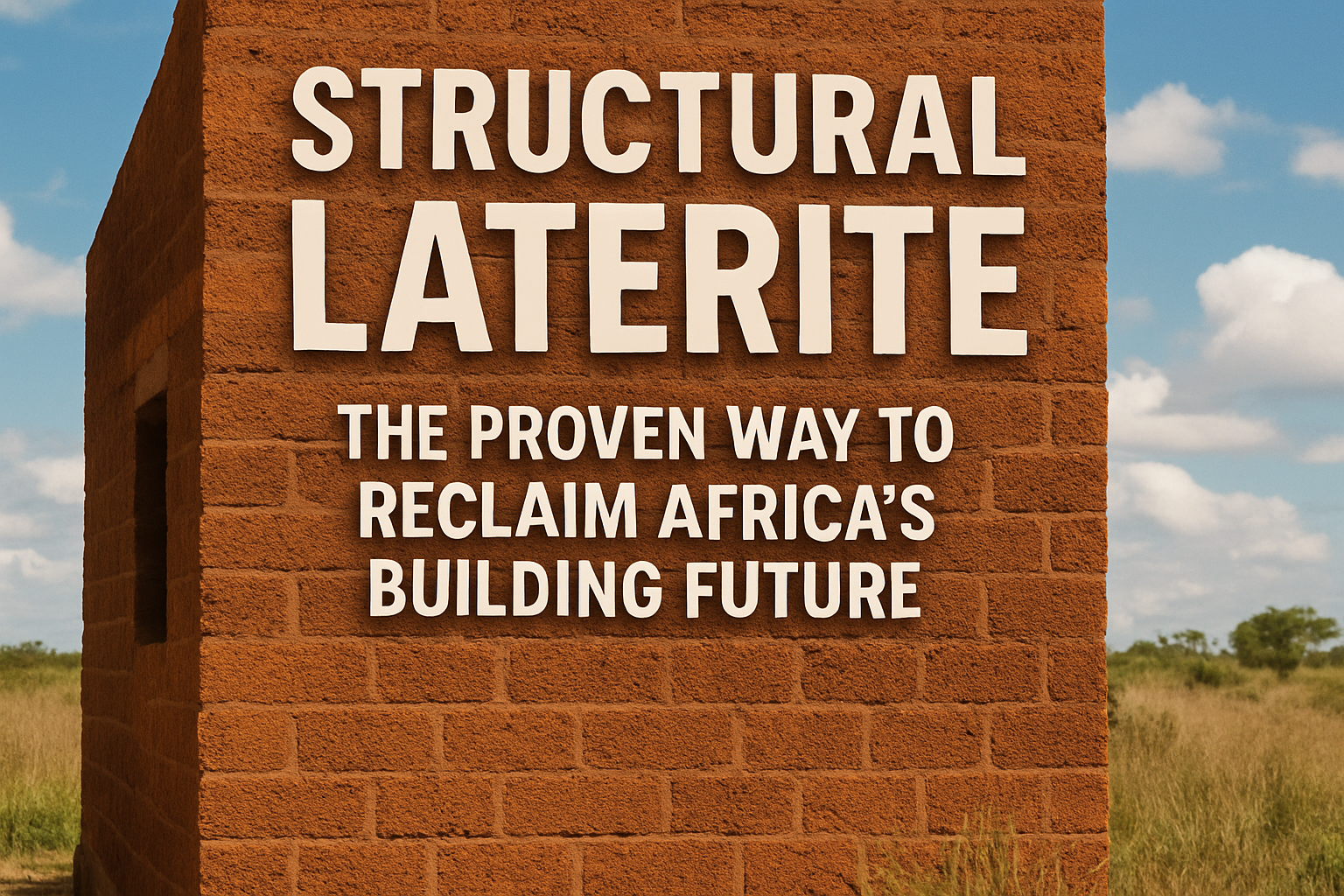
This approach does not romanticise mud. It modernises it. Compressed laterite blocks achieve reliable tolerances. Hybrid systems allow seismic reinforcement. Roof spans extend through bamboo trusses. Performance improves through testing, not nostalgia.
Climate sharpens the case. Laterite moderates diurnal swings in the Sahel. Thick walls store coolness through the afternoon. Shaded openings reduce glare. Cross-ventilation flows through breathable envelopes. Mechanical cooling becomes supplementary, not essential.
Consider cost as well. Imported cement fluctuates with currency shifts. Laterite anchors value locally. Quarrying, cutting and laying create regional employment. Skills remain within communities. Supply chains shorten. Critics fear durability. Poor detailing causes most failures. Rain splash erodes unprotected bases. Inadequate roof overhangs invite decay. Design solves these weaknesses swiftly.
Look to Senegal’s rural schools or northern Ghana’s civic buildings. Architects such as Francis Kéré have proven earth’s structural dignity. Their projects demonstrate precision, not improvisation. They show that beauty and performance can align. Urban regulation must evolve. Building codes often privilege concrete by default. Policymakers should test laterite assemblies formally. Standards can legitimise what tradition already knows. Once codified, confidence grows.
Material choice shapes urban character. Laterite offers warmth and texture. It grounds streets in ochre light. Bamboo screens filter sun into patterned shade. Timber lintels soften thresholds. Palm and raffia provide secondary shading. Stone stabilises plinths in flood-prone zones.
Together these materials create layered resilience. They also express place. A city built from its soil feels anchored. Identity ceases to imitate distant skylines. Importantly, this shift resists fetishism. Laterite and bamboo do not replace engineering judgement. They expand it. Concrete and steel still serve in bridges and high-rise cores. The aim is balance, not prohibition.
Design carries moral weight. Every tonne of cement embeds carbon. Every imported beam extends extraction elsewhere. Laterite reduces that burden materially and symbolically. It reminds us that construction can cooperate with landscape. Urban growth across West and North-West Africa accelerates rapidly. Housing demand surges. Infrastructure strains. In this context, structural laterite offers scale without surrender. It aligns climate logic with cultural memory.
We must treat it as structure again. We must test it, refine it and regulate it properly. Confidence will follow competence. Cities will regain material coherence. Laterite does not whisper weakness. It speaks of grounded modernity.
Structural Laterite: The Proven Way to Reclaim Africa’s Building Future
I have not posted since the end of 2025. I needed to time away to…
Bamboo Urbanism: The Proven Way to Reclaim Flood-Prone African Streets
Not every African city began beside water. Many Sahelian settlements grew around wells, wadis and…
Human-Scale Neighbourhoods: The Proven Way to Build Strong, Sustainable Cities
Urban life thrives when its parts fit the human body and mind. Streets, squares and…
Bamboo Cluster Neighbourhoods: The Proven Way to Advance African Eco-Urbanism
Last week’s post revived sociability through human-centred streets. This post shifts towards the home. I…
Human-Centred Streets: The Proven Way to Reclaim African Urban Sociability
Every city tells a story through its streets. They reveal how people live, how they…
Biophilic Design: The Proven Way to Shape Sustainable African Communities
A city breathes when its architecture remembers nature. Too often, our modern buildings forget this….