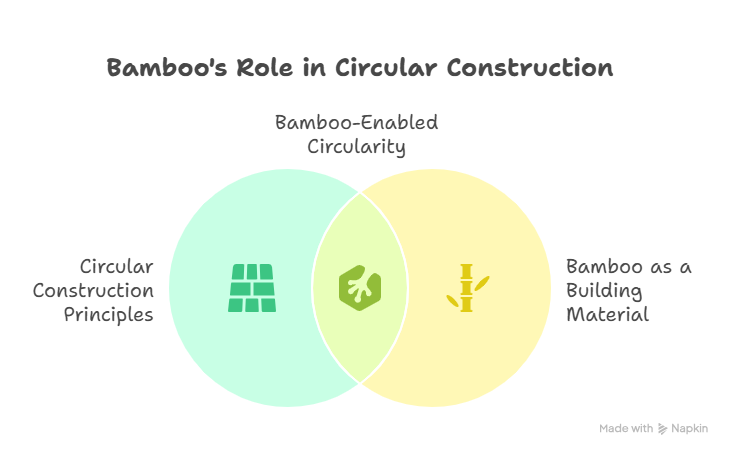
Urban planning should serve both the city and its people. That principle lies at the heart of sustainable development. When we speak of circularity in construction, we speak of more than recycling. We refer to a system where buildings respect resource limits, regenerate natural systems, and strengthen social bonds. In this, bamboo has a rightful place—not as novelty but necessity.
A Material of Regeneration
Bamboo grows quickly and renews itself without need for replanting. Most species reach maturity within three to five years. It absorbs carbon while it grows and stores it once harvested. Unlike concrete or steel, it demands little energy to process. It thrives across climates—temperate, tropical, and subtropical—and offers structural strength, flexibility, and lightness.
In Northwest and West Africa, bamboo grows with little irrigation or chemical input. In Western Europe, while not native, select species can be cultivated and processed responsibly, or imported from certified sources. Its circular value lies not just in renewability but in repairability, reuse and biodegradability. When buildings reach the end of their use, bamboo elements return to the soil rather than polluting it.
Design for Disassembly
Circular construction demands that buildings remain adaptable. Materials must be recoverable. This requires modular systems, mechanical joinery and design for disassembly. Bamboo lends itself well to such an approach. You can shape it into panels, beams or frameworks. You can fix it without adhesives that contaminate the material. It responds to precision and care. It works with nature, not against it.
Urban Form Rooted in Stewardship
When we speak of neighbourhoods shaped by circular design, we imagine more than materials. We picture spaces that foster dignity and connection. Bamboo, in schools, shelters, pavilions and street furniture, softens the built environment. It tempers heat, calms noise, and signals care. Its warmth and texture remind us of the earth’s abundance and fragility. In dense cities, it helps restore a human scale.
Planners must lead with an ecological ethic. We must design for generations. Materials like bamboo allow us to do so with clarity and restraint. They hold potential not only in informal settlements or rural contexts, but in the heart of the metropolis. Their presence in buildings speaks of resource wisdom and cultural humility.
Policy to Match the Mission
Circular construction requires more than good intentions. It needs policy alignment. Metropolitan governments must create material passports, support bamboo research, and remove legal barriers to alternative materials. They must adjust building codes to allow structural use where safe and tested. Public procurement should favour local, regenerative materials. Pilot projects in housing, public buildings and open spaces should lead the way.
Trade policy must support responsible bamboo economies. Urban planning departments should work with agricultural and forestry agencies to ensure sustainable sourcing. Cross-continental collaboration can link supply chains from Asia and Africa to Europe, building capacity and equity.
From Regrowth to Renewal
Bamboo does not solve every challenge. But it reminds us what true sustainability looks like—fast-growing yet enduring, flexible yet strong. Circularity in construction means seeing buildings as part of a larger system: ecological, social, and civic. Materials matter. So do the systems that deliver them, the policies that shape them, and the people who live among them.
To build with bamboo is to build with foresight. It is a decision not only about material, but about values. In a time of climate crisis and social division, such decisions matter. They speak of repair. They open the door to futures rooted in care, and built to last.
Seamless Transition to New Platform
After careful consideration, I have decided to migrate the content of this blog to a…
Passive Cooling: The Proven Way to Reclaim Climate-Smart African Building
Cooling begins with the wall. Machines should come later. Across West and North West Africa,…
Courtyard Urbanism Revisited: Privacy, Density and Social Balance
The courtyard begins as an absence. It becomes the centre. Across West and North West…
The Proven Way to Build Future-Ready, Sustainable Engineered Bamboo Frames
Structure begins with load. Everything else follows. Engineered bamboo frames require exact thinking. They reward…
The African Street Section: The Proven Way to Reclaim Better Streets
Heat shapes the street before any architect intervenes. Light, dust, wind, and rain follow with…
Structural Laterite: The Proven Way to Reclaim Africa’s Building Future
I have not posted since the end of 2025. I needed to time away to…